
May 17, 2012
  • Share on Tumblr
  • Email
  • Sharebar

50,000 Dead Since 2006 In Mexico’s Drug War?
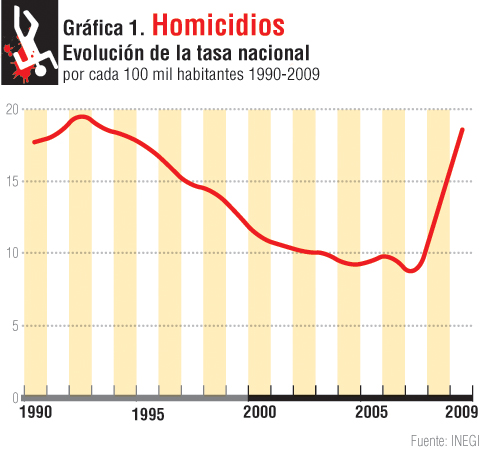
According to some Mexican reports, the death tally in Mexico that has followed President Felipe Calderón’s “drug war” begun in 2006 may surpass 50,000. This article says the total from 2008 to 2009 is 47,000 and not 30,000 that has been reported. That’s just two years, what about the deaths in 2006, 2007 and 2010? Staggering. Another in-depth report goes even further into the numbers.

As you can see from the above graphic and as author Fernando Escalante Gonzalbo points out, 2009 was the most violent year in Mexico’s history. But Gonzalbo says he doesn’t buy the official explanation for this jump as just being the drug war alone. What he says is, “Y la lógica dice que el movimiento tiene que ver con el despliegue de tropas y policía federal,” or in English, “And logic tells us that this movement (of numbers) has to do with the deployment of troops and federal police.”
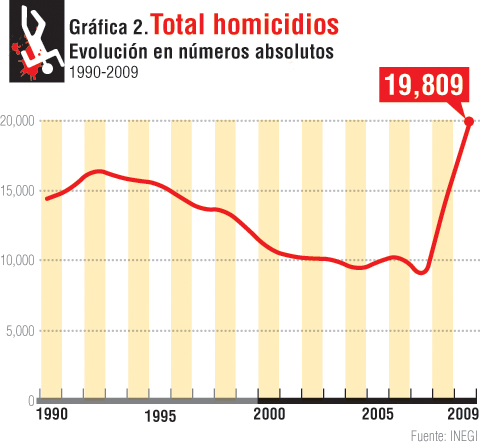
Which is to say, Gonzalbo is blaming Calderón’s drug war for the increase in deaths after an excruciatingly in-depth analysis of the numbers.

But it’s not the drug war in and of itself, but rather, the sudden change in the way the law is applied in Mexico. In his words, “Mi impresión es que en los últimos años, en el empeño de imponer el cumplimiento de la ley, en el empeño de imponer el Estado de derecho a la mala, desde el ejecutivo federal, se han roto los acuerdos del orden local y cada quien tiene que proteger lo suyo de mala manera,” or, “My impression is that in the past few years, in efforts to enforce the law, in the effort to take the State from bad to worse from the executive level, the local agreements of order were broken and every one has to protect themselves in the worst way.”

[Images courtesy Nexos]

About Sara Inés Calderón

Sara Inés Calderón is a Latina journalist and bloguera suprema. She loves news, chisme, social media and dangly earrings. Follow her on Twitter @SaraChicaD.
  • Pingback: Stopping Drug War Carnage in Mexico « DadOnFire

  • Pingback: Mexico Drug War Aid Delays Investigated | NewsTaco

  • http://www.facebook.com/people/Michael-Reimer/8805593 Michael Reimer

    It’s long been my impression that a culture of violence, inspired and motivated by the drug war and the media’s coverage thereof, has had a striking effect on the way ordinary Mexicans handle themselves in every manner of daily life, especially in cities and regions most affected. Hearing stories in once famously-secure cities like Monterrey (albeit anecdotal evidence), I’m struck by what I perceive to be an increased use of violent means to “resolve” disputes and manage everyday incidents. Indeed, persisting lack of governance and ineffective law enforcement is a contributing factor, but is there any evidence that municipal and state police forces are less effective in arresting criminals now than they were before the deployment of troops and federales?

    I wonder if there is any literature on this, particular to the case of Mexico during the Calderón’s sexenio.

  • Pingback: Tweets that mention 50,000 Dead Since 2006 In Mexico’s Drug War? | NewsTaco -- Topsy.com

  • Maxi

    Many argue in Mexico that local law enforcement was part of the problem in sections of the country-that they had colluded with organized crime. Thus, part of the “drug war” involved attacking that very relationship and the war came to the local level from the federal level vis-a vis the army and federal police.

    Consider the translation of Escalante’s quote, “en el empen/o de imponer el Estado de derecho a la mala… “, to mean, “.. in the quest to impose the rule of law, without discussion, from the federal executive, it has broken the agreements of the local order and each one in that relationship is protecting what’s theirs in the worst manner.” A commonly used expression in Spanish is , “Por las buenas o por las malas, pero esto se va hacer” and it means, “By the easy way or by the hard way, but this will get done.” In this case, ‘ a la mala” implies that the easy way was no longer an option to enforce the law, the mere expection of straight up, honest law enforcement had been rendered mute by corruption. Thus, the hard way came into play and the army and federal agents stepped in to enforce the law, without discussions.

    How to enforce the law when local officials have failed in their duty as public servants by being complicit with criminals? The federal gov’t. moved in with better equiped, better trained soldiers and acting- in the national interest- to remove this criminal element. Of course the tainted at the local level fought back to protect their turf, vested interests. This was the hard way to imposed “the rule of law.”

    When Calderon was a candidate, he never campaigned for a war against drug cartels- there was no mention of it on his platform. It was only after he was in Los Pinos ( the Mexican equivalent of The White House) that he called out the army to engage in this battle against “el crimen organizado”. President Calderon said at that time, over four years ago, that Mexico had to act to eradicate this threat against the nation. He asked, “How will we answer our grandchildren in the future when they ask why we didn’t do anything to stop them (organized crime) from taking over our counrty? The mobilization of troops was the president’s directive, an executive order. Many argue further that Mexico’s drug war is a war for it’s very sovereignty