
Looking at the most recent Census data allows us to obtain a clearer picture of how, precisely, Latinos are growing as a population in this country. However, looking at this data in graphic form can often be much more insightful. Below is a chart I compiled from Census data and an accompanying map.
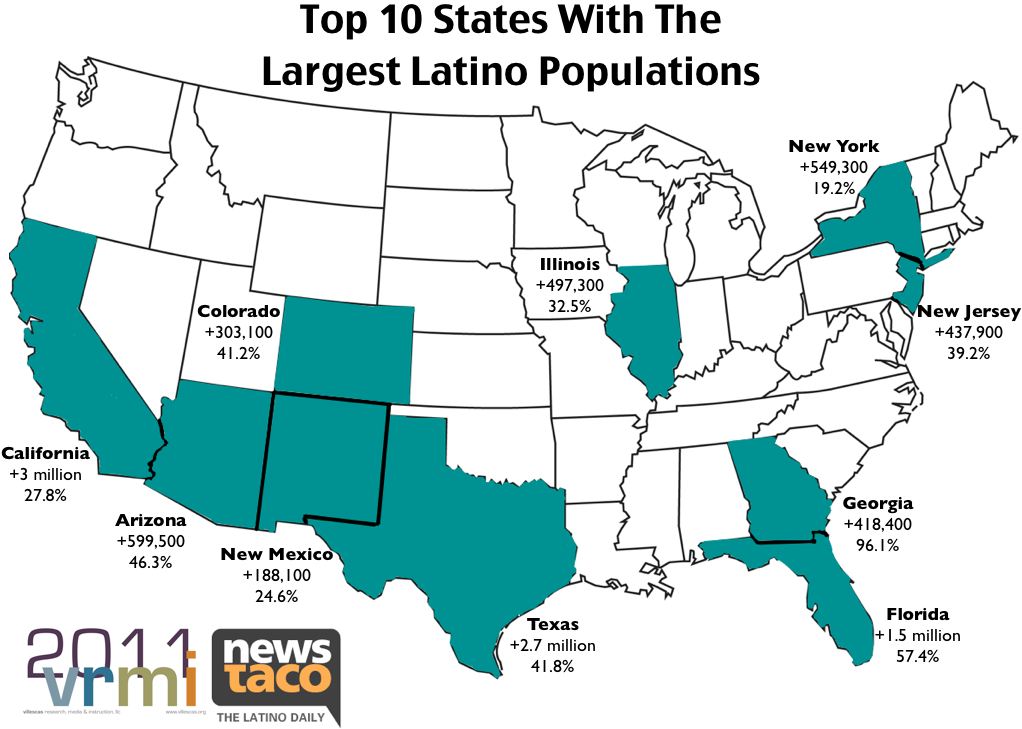
The data from the Census are compiled in a chart below:
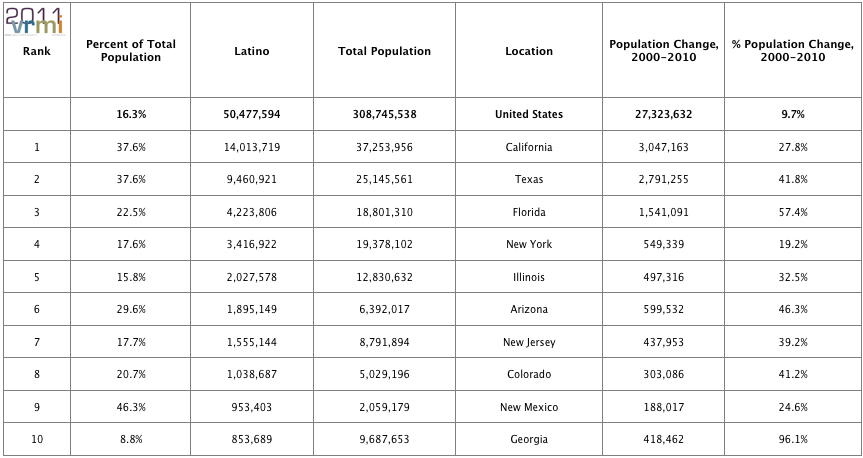
*Note: Over half of the U.S. Latino population lives within California, Texas and Florida.
Joseph P. A. Villescas, Ph.D. is an independent consultant, writer and instructor who conducts extensive investigations on Latino and other multidimensional populations that explore trends in their educational development, media consumption, internet usage, voting behaviors, racial categorization, organizational capacities and readiness for future leadership roles in community settings. He is also the founder and owner of Villescas Research, Media & Instruction, LLC.
[Image By News Taco]

You must be logged in to post a comment.


[...] …remember Oregon has one of the largest Hispanic populations in the country. Wrong again: http://www.newstaco.com/2011/06/14/t…o-populations/ & http://www.infoplease.com/spot/hhmcensus1.html Last edited by kapetrich; Today at 01:33 [...]
Good job Mr. Villescas! Keep up the good work.
[...] these, Colorado and New Mexico are among the top ten states with the largest Latino populations. Pennsylvania is among the 16 states with Latino populations [...]
[...] as we wrote before, the Latino population that is historically concentrated in the Southwest is growing, but so is a newer population on the East Coast. The Associated Press reported: The preliminary figures are based on an analysis of the Current [...]
[...] week we looked at the Top 10 States With The Largest Latino Populations. As I wrote then, understanding these trends is important not only to how Latinos are growing in [...]
you might want to add to the map heading that the numbers represent POPULATION CHANGE. otherwise, the percentages could be easily misinterpreted to represent the total percent of latinos in those states.
[...] Both sides of my family have long resided in the borderlands, specifically El Paso and Ciudad Juárez, but recently on the American side for just over one hundred years. During that past century each generation of my family has borne witness to population trends that, through heightened fertility and immigration rates, have produced a United States that is increasingly Latino. [...]
[...] the ways in which pollsters surveyed Latino voters, but given our recent post covering the concentrations of Latino populations in the U.S., it occurred to me that Spanish surnames are probably one of the things that will change with [...]
[...] The Top 10 States With The Largest Latino Populations [...]