
Latino Students Are Not The Children Of Sanchez
 Latino students from kindergarten through high school are, on average, two years behind their white peers. That much is proven fact. But it’s not the most distressing news. The unacceptable thing is that it’s been that way for twenty years.
The latest test results tell the story.
The National Center for Education Statistics (NCES) published their latest report with a very long name: Achievement Gaps: How Hispanic and White Students in Public Schools Perform in Mathematics and Reading on the National Assessment of Educational Progress. It makes official what many folks in education know by experience – Latino kids score 20 points lower than white kids in math and reading. News Taco recently published an excerpt of the study that breaks down standardized test scores and compares them across ethnic, racial and cultural lines; the results surprised very few people.
Things haven’t changed in 20 years.
This is the part of the study that should anger people – the fact that nothing has changed in 20 years; not the scores, not the schools, not the teaching methods. We know better. We know, for example, that a large percentage of Latino children live in poverty, and because of that they learn differently than children who live in more affluent communities. The challenge, though, is twice as difficult for Latinos because of per-conceived ideas. For that we can point to an iconic novel.
Paul Gorski, assistant professor at George Mason University and founder of EdChange, writes in his essay “The Myth of the Culture of Poverty”:
Oscar Lewis coined the term culture of poverty in his 1961 book The Children of Sanchez. Lewis based his thesis on his ethnographic studies of small Mexican communities. His studies uncovered approximately 50 attributes shared within these communities: frequent violence, a lack of a sense of history, a neglect of planning for the future, and so on. Despite studying very small communities, Lewis extrapolated his findings to suggest a universal culture of poverty. More than 45 years later, the premise of the culture of poverty paradigm remains the same: that people in poverty share a consistent and observable “culture.”
Four myths prevail:
- Parents are uninvolved in their children’s learning, largely because they do not value education.
- They are are linguistically deficient.
- They tend to abuse drugs and alcohol.
- They are unmotivated and have weak work ethics.
Over the past 50 years studies, history and research have proven his theory wrong. There is no culture of poverty, but there are circumstances of poverty. The danger in decades of unacceptable scores is that they strengthen biases. It goes something like this: If grades haven’t changed in 20 years, then something must be wrong with the students.
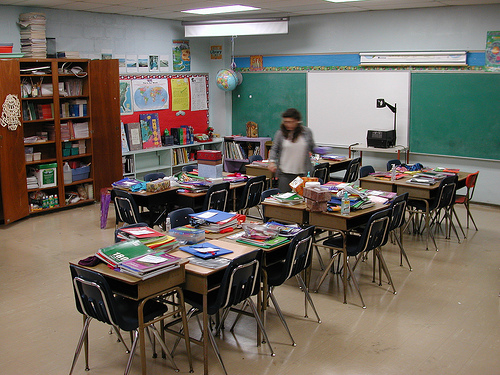
But schools haven’t changed in 20 years either; they still look and feel like they did 50 years ago.
We know that poor kids learn differently. We also know that immigrant kids arrive in U.S. schools with language barriers. And we know that together, the poor and the immigrant, make up a large portion of the Latino student population; the largest minority population in U.S. schools. Add to that the fact that achievement scores have remained mostly unchanged for 2 decades and you get a model for a classic, self-fulfilling, vicious cycle. The low scores shouldn’t surprise us.
The change must come from outside the schools as well as from within.
Gorski gives us a number of things we can do to make a change; I’ll mention a few:
- Educate ourselves about class and poverty.
- Make school involvement accessible to all families.
- Continue reaching out to low-income families even when they appear unresponsive (and without assuming, if they are unresponsive, that we know why).
- Respond when teachers stereotype poor students or parents.
- Never assume that all students have equitable access to such learning resources as computers and the Internet.
- Ensure that learning materials do not stereotype poor people.
- Fight to keep low-income students from being assigned unjustly to special education or low academic tracks.
- Make curriculum relevant to poor students, drawing on and validating their experiences and intelligences.
We’ve said in the past that the Latino education gap is a national, economic emergency. But it’s not like we don’t know what to do about it.
Follow Victor Landa on Twitter: @vlanda
[Photo by [Photo by Bart Everson]